June 13, 2026
Birthday Party for Mixed Interests: 6 to 9 Year Olds
Planning a birthday party for 6 to 9 year olds with different interests? Discover games, themes, and activities that engage every guest on your list.
How to Plan a Birthday Party for a 6- to 9-Year-Old When the Guest List Is Mostly Boys and Girls with Very Different Interests
You're staring at the guest list and it hits you: half the kids want to run obstacle courses, the other half want to build friendship bracelets, and your child invited them all. Now you need a party plan that doesn't bore anyone or trigger a mutiny.
This happens more often than you'd think. Planning a birthday party for mixed ages and interests isn't about finding one magic theme that pleases everyone (spoiler: it doesn't exist). It's about building a party structure that gives everyone something they'll actually enjoy, without you orchestrating three separate events.
Here's how to plan a kids birthday party for mixed interests without losing your mind.
Start with a Simple, Broad Theme That Doesn't Box Anyone In
Forget hyper-specific themes like "dinosaur paleontologist" or "unicorn tea party." Those work great for a cohesive group, but they alienate half your guests when interests diverge.
Instead, choose a simple birthday party theme for a mixed group that leaves room for interpretation. Think "outdoor adventure," "game show," "science lab," or "art studio." These themes are wide enough to include different activity types without feeling disjointed.
For example, an "adventure" theme can include a scavenger hunt (active), nature observation stations (calm), and trail mix decorating (hands-on). A "game show" theme works for relay races, trivia, and minute-to-win-it challenges that let kids self-select their involvement level.
The key is picking a theme that supports variety, not one that demands everyone do the same thing.
Plan Party Activities for Boys and Girls with Different Interests Using Stations
This is the single biggest shift that makes mixed-interest parties work: instead of one group activity everyone rotates through together, set up 3 to 4 stations kids can move between freely.
Here's why stations solve the problem. Some kids want to sprint and compete. Others want to build, create, or observe. Stations let both happen at once without anyone feeling dragged through an activity they hate.
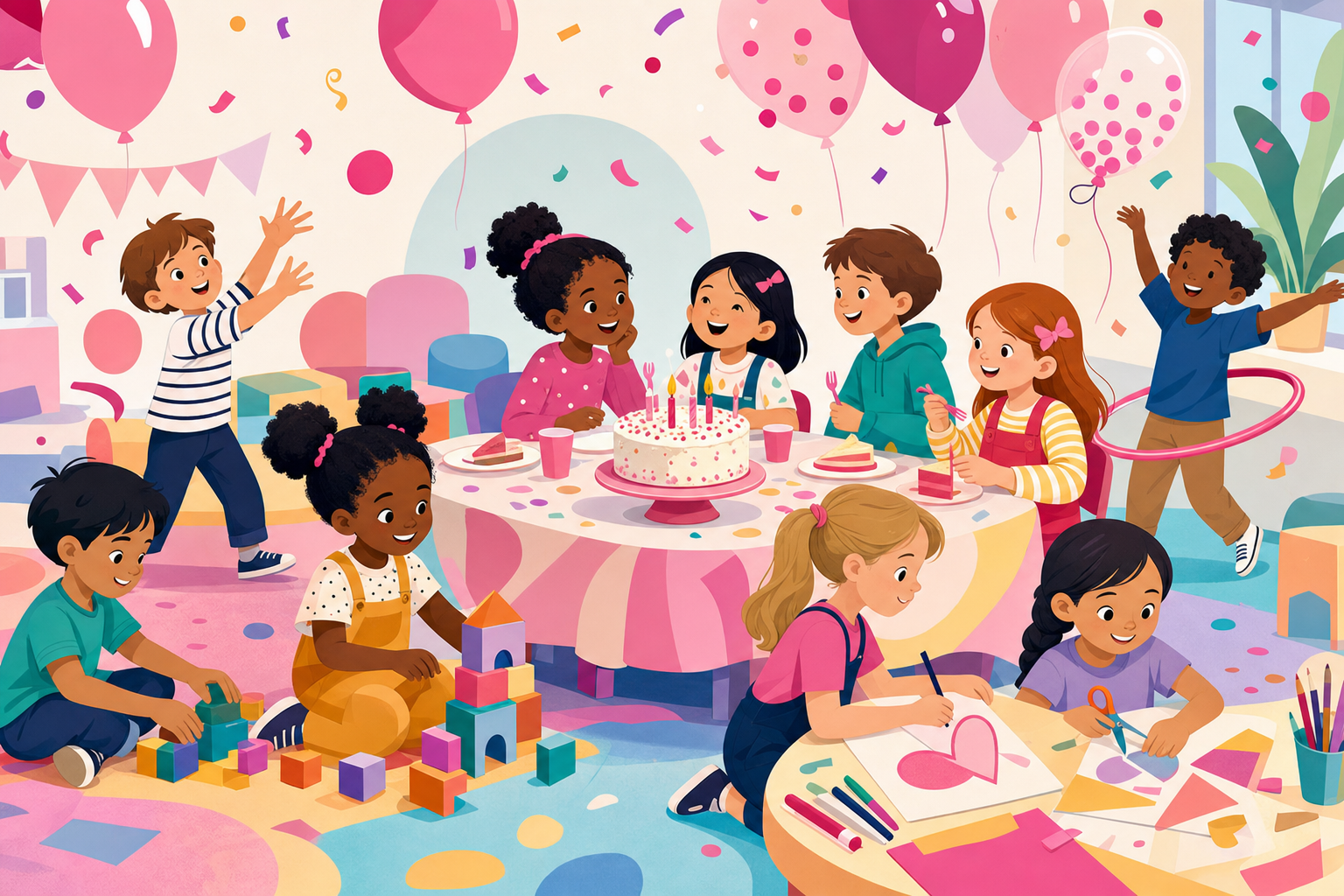
Set up one high-energy station (relay race, obstacle course, dance-off), one calm hands-on station (craft, building challenge, science experiment), and one semi-active station that works as a buffer (scavenger hunt, photo booth, group drawing game). If you have space, add a "chill zone" with books, puzzles, or quiet games for kids who need a break.
Rotate kids every 10 to 12 minutes, or let them move freely if your space and supervision allow it. Free movement works better for 7- to 9-year-olds who can self-regulate. Timed rotations work better for younger kids who need more structure.
For a simple station setup, themed coloring sheets from Chunky Crayon make an easy calm-down activity that doubles as a take-home favor.
Choose Birthday Party Games for 6 to 9 Year Olds That Scale Up or Down
Not every game needs to be a station. You'll still want 1 to 2 group games that bring everyone together, especially right after cake when energy spikes.
The trick is choosing kids party activities everyone will enjoy because they let kids participate at their own intensity level. Here are three that work:
Freeze dance or musical statues. Kids who want to go wild can dance dramatically. Kids who feel shy can sway in place. Everyone's playing the same game, but no one's forced into a single mode.
Scavenger hunt with team roles. Some kids hunt for items, others check them off the list, others guard the collection bag. Different roles = different energy levels, same game.
Relay races with silly tasks. Balance a ball on a spoon, waddle like a penguin, or spin three times before tagging the next person. The silliness levels the playing field so it's not just about who's fastest.
Avoid games that require everyone to be equally competitive or equally comfortable performing. Skip things like musical chairs (too cutthroat), talent shows (too much pressure), or long team sports (too much skill variance).
If you're planning a party with a wide age range, the same station approach applies. You can adapt the structure from this guide on planning a party when siblings and cousins span multiple ages.
Keep the Party Flow Tight and Predictable
Mixed-interest groups get chaotic fast if kids don't know what's happening next. A clear, tight schedule keeps everyone regulated without feeling overly rigid.
Here's a birthday party planning for a split-interest guest list structure that works for 90 minutes:
- 0 to 10 minutes: Free play as guests arrive (bubbles, sidewalk chalk, or balls in the yard)
- 10 to 40 minutes: Station rotations (3 stations, 10 minutes each)
- 40 to 55 minutes: Snack or cake
- 55 to 75 minutes: One group game (freeze dance or scavenger hunt)
- 75 to 90 minutes: Quiet wind-down activity (coloring, stickers, or goodbye circle) and pickup
This flow gives high-energy kids multiple outlets and gives calmer kids predictable breaks. The group game after cake uses the sugar rush productively, and the wind-down prevents a chaotic pickup where half the kids are melting down.
If you're hosting solo and need a tighter timeline, check out this 90-minute backyard birthday party plan designed for one adult. It's built for ages 4 to 7 but the flow principles apply.
Give Kids an Out Without Making Them Feel Left Out
Some kids will opt out of activities, and that's fine. The goal isn't forced participation; it's making sure every kid has something they want to do.
Set up a designated "break zone" with a blanket, a few books, or a quiet toy. Tell kids at the start, "If you need a break, you can hang out in the chill zone for a few minutes." This works especially well for kids who get overstimulated or need to recharge between activities.
Don't make a big deal if a child skips a station or sits out a game. Just check in briefly ("You doing okay?") and let them rejoin when they're ready. Most kids will jump back in once they see something that interests them.
For kids who are naturally more reserved, you might find these low-stress party ideas for shy kids helpful. The principles around giving kids control and avoiding forced participation apply here too.
Keep Food and Favors Simple and Universal
This isn't where you solve the interest problem. Keep food simple, allergy-friendly, and fast.
Pizza, fruit, veggies, and a simple cake work for everyone. Skip elaborate themed snacks that only half the kids will recognize or appreciate.
For favors, avoid gender-specific or interest-specific items. Instead, choose things every kid uses: stickers, bubbles, sidewalk chalk, play dough, or a small pack of markers. If you did a craft station, that project becomes the favor and you're done.
The Real Win: Everyone Leaves Happy (Including You)
Planning a birthday party for mixed ages and interests doesn't mean doing twice the work. It means building flexibility into your plan so kids can self-select their experience.
Stations, scalable games, a tight flow, and a broad theme give you a party structure that works for energetic kids, calm kids, and everyone in between. You're not trying to make everyone do the same thing. You're giving them options within a framework you can actually manage.
And that's a party everyone can enjoy, including the parent who just pulled it off.