October 23, 2026
First 15 Minutes of a Kids' Birthday Party, Sorted
Low-prep arrival activities to keep ages 4 to 8 busy while guests trickle in. Simple birthday party transition games that actually work.
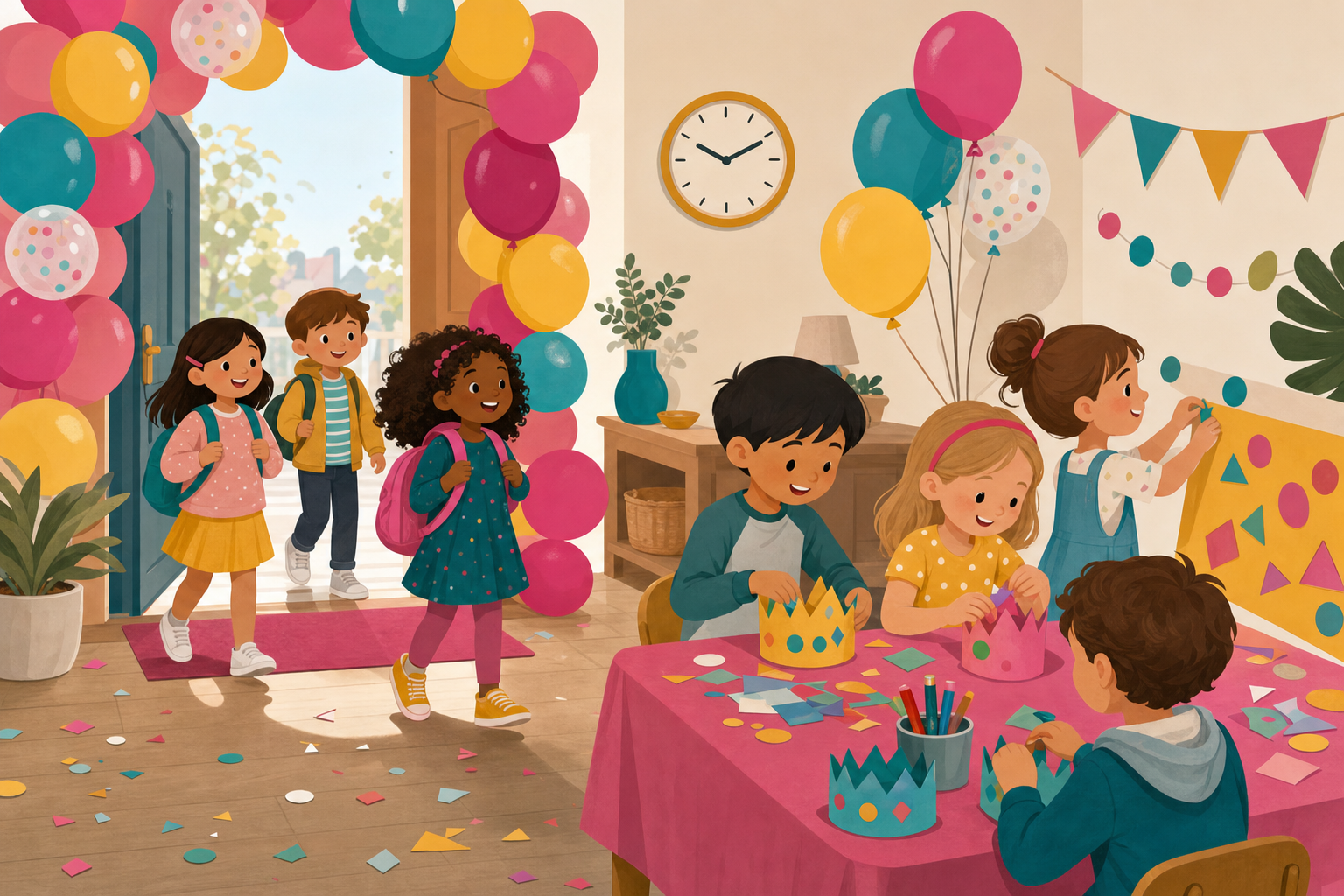
What to Do During the First 15 Minutes of a Kids' Birthday Party (Ages 4-8)
The first 15 minutes of a birthday party are the hardest part, and nobody warns you. Half your guests show up at 2:00 sharp, three kids trickle in by 2:20, and you're standing in the doorway holding a gift bag while your own kid asks when the piñata happens. You need a plan for this window specifically, not just a general party timeline.
Most party advice tells you to do "arrival and free play" and moves straight to games and cake. That's fine in theory, but it ignores the real problem: birthday party late arrivals mean you're running two parties at once for the first quarter hour, one for kids who showed up on time and are already bored, and one for kids who just walked in and don't know anyone yet. Here's a run of show that actually accounts for that.
Why the First 15 Minutes Make or Break the Party
Kids arriving to a birthday party are often shy, overstimulated, or clingy to a parent at the door. If there's nothing to do, they either glue themselves to you or start running wild through the house before the actual party has even begun. Both are hard to walk back later.
A good birthday party arrival activity does three things:
- Gives kids something to do with their hands immediately, no instructions needed
- Works whether one kid or six kids are present
- Doesn't require you to referee or explain rules while you're still greeting families
This is a drop-in activity, not a game. Games need a critical mass of players and a host to run them. A drop-in activity just needs a table and a bin.
The 0 to 5 Minute Mark: One Low-Prep Station, No Instructions
Set up a single station near the entrance before the first guest arrives. Not three stations, just one. You want kids walking from the door to this table without you saying a word.
Good options that take under 10 minutes to set up:
- A name-tag or birthday-hat decorating table with stickers and markers
- A bin of building blocks or magnetic tiles dumped on a low table
- Blank paper and crayons set out for open drawing
- A simple scavenger hunt list taped to the wall (find something red, find something round)
Themed coloring sheets work especially well here because they need zero explanation and every age from 4 to 8 can do them at their own level. If you're short on time, printable sheets from Chunky Crayon matched to your party theme give kids something to dive into the second they walk in, without you lifting a finger.
Place this station in direct line of sight from the front door. When a new family arrives, you want your own kid or an older guest to be able to point and say "it's over there" instead of you stopping to explain.
The 5 to 10 Minute Mark: Let the Birthday Kid Be the Guide
Once three or four guests have arrived, hand the social job to your child instead of doing it yourself. Most 6 to 8 year olds love being put in charge of something small.
Try one of these:
- "You're in charge of showing everyone the coloring table."
- "Can you give each friend a sticker when they come in?"
- "You're the greeter, you say hi and show them where to put presents."
This does two things. It gives your own child a job that keeps them near the door instead of disappearing to play alone, and it takes the social pressure off shy guests because another kid, not an adult, is welcoming them.
If you've got a shy kid of your own or a guest who hangs back, this works alongside the kind of structure used in visual transition schedules for kids: knowing exactly what happens next (drop off present, color, wait for friends) lowers anxiety more than open-ended "go play" instructions ever will.
The 10 to 15 Minute Mark: Bridge Into the Group Activity
By minute 10, you likely have most of your guests. This is the transition point where the open drop-in activity needs to fold into something slightly more structured, without abandoning the kids who are still mid-coloring page.
A few ways to bridge this without a hard stop:
- Announce a 2-minute warning: "Two more minutes at the craft table, then we're doing a quick game!"
- Use a timer or a song that signals transition (the same song every year becomes a nice tradition)
- Let kids bring their finished craft with them to the next activity instead of forcing them to leave it behind
This matters more than it sounds like. Birthday party transition games fail most often because the switch is abrupt and kids who weren't done with the last thing resist the new one. A countdown gives everyone a chance to finish their thought.
If a guest arrives during this transition (it happens almost every time), don't restart the whole group. Quietly point the latecomer to the activity station for a few minutes while the group moves on. One adult helper peeling off to greet stragglers works better than pausing 10 kids to wait for one.
Building Your Full Run of Show Around This Window
Once you've nailed the first 15 minutes, the rest of the party timeline gets much easier to plan because you're not improvising at the hardest moment. A simple run of show might look like this:
- 0 to 15 min: Drop-in activity station, birthday kid as greeter, staggered transition
- 15 to 35 min: Main group activity or game
- 35 to 50 min: Second activity or craft, lower energy
- 50 to 65 min: Cake and food
- 65 to 90 min: Free play, presents, wind-down
Write this timeline on a sticky note in the kitchen. You will not remember it once the party starts, and that's normal.
It's also worth thinking ahead to the other end of the party. A plan for the first 15 minutes pairs well with a plan for the last 20, when you're exhausted and the house is a mess. The 20-minute solo cleanup plan covers exactly that stretch, and the 20-minute drop-in plan for early arrivals goes deeper if you tend to get a flood of guests right at the start time instead of a trickle.
The One Thing to Remember
You don't need a complicated opening act. You need one low-prep station that kids can walk straight into, a small job for your own child, and a soft countdown into the next activity. That's it. The goal isn't to entertain anyone for 15 minutes, it's just to give every kid something to do with their hands until the party officially starts, no matter when they walk through the door.