October 9, 2026
Kids Birthday Party Food Timing: Before or After Games?
Confused when to serve food at a kids party? Get a simple 90-minute birthday party timeline that balances snacks, games, and happy, well-fed guests.
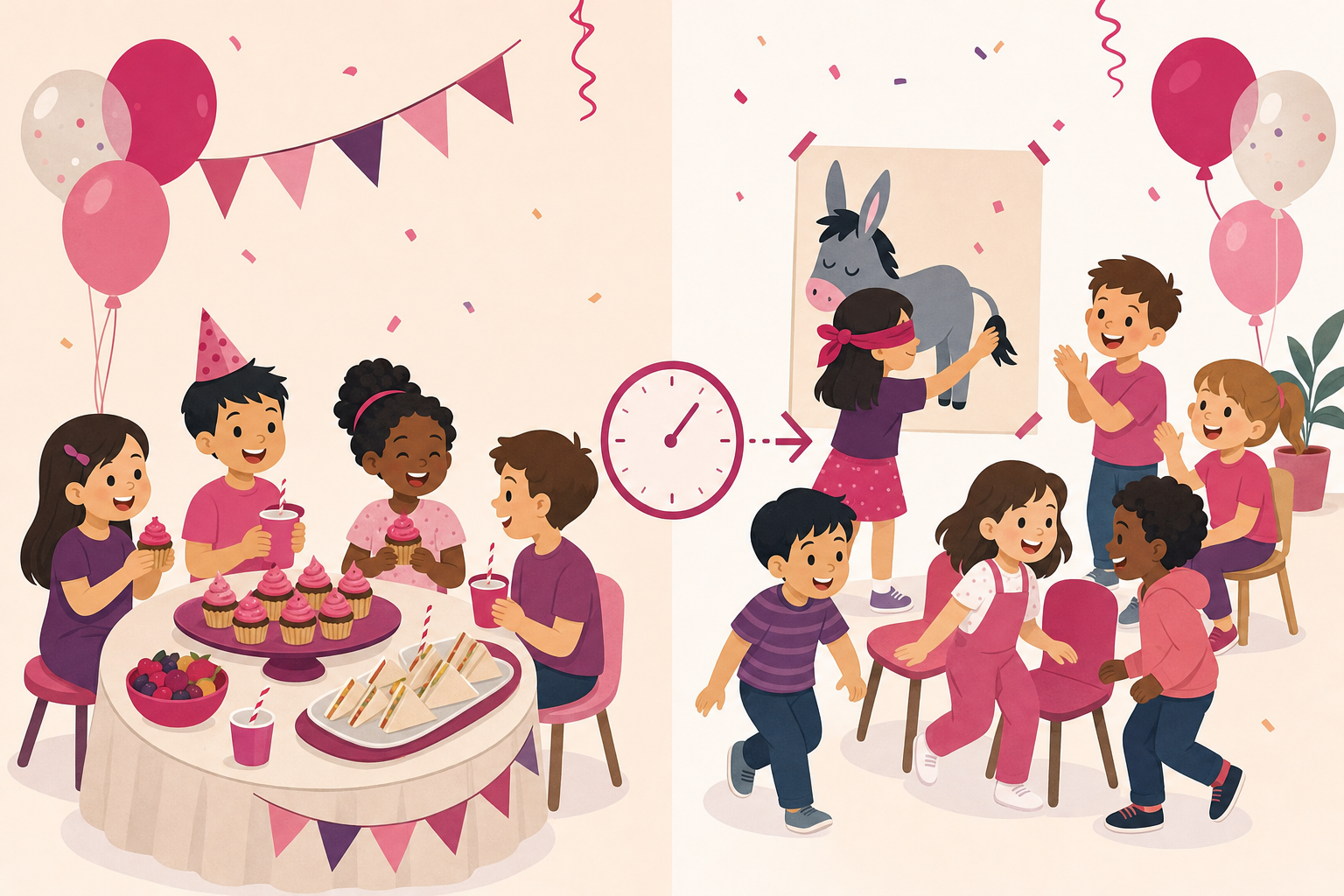
When Should You Serve Food at a Kids' Birthday Party? A Simple Before-or-After-Games Plan for 90-Minute Parties
You're twenty minutes into the party and a six-year-old is tugging your shirt saying "I'm hungry" while three other kids are mid-tantrum over musical chairs. Food timing feels like a small detail until it's the thing that derails your whole party. Get it right and the afternoon flows. Get it wrong and you're serving cake to a room of overtired, overstimulated kids who won't sit still long enough to sing.
There's no single right answer for every party. The right order depends on your start time, the ages in the room, and how predictable your guest list is. Here's how to actually decide, not just a generic timeline to copy.
Why "Just Follow a Template" Doesn't Work
Most party schedules you'll find online say something like: arrival, activity, food, cake, presents, goodbye. That works fine on paper. In real life, three things blow it up:
- Party time collides with a meal window. An 11am party sits right on top of lunch. A 4pm party sits in the danger zone before dinner when blood sugar is already low.
- Kids arrive at different times. If guests trickle in over 20 minutes, serving food too early means latecomers miss it, and serving it too late means early arrivals are starving and cranky before games even start.
- Active games and full bellies don't mix. Nobody wants to referee a kid who just ate cake and juice box through a relay race.
The fix isn't a fixed order. It's a decision tree based on your actual party.
The Decision: Does Your Start Time Overlap a Meal?
This is the single biggest factor in kids birthday party food timing, more important than age or guest count.
If your party starts within an hour of a normal mealtime (think 11:30am to 1pm, or 5pm to 6:30pm), feed first. Kids who are already hungry when they arrive will not have the patience or focus for games, and a hungry kid is a meltdown waiting to happen. Serve a light meal in the first 15 to 20 minutes, then move into activities once bellies are settled, not stuffed.
If your party starts in a clear in-between window (think 10am, 2pm, or 3:30pm), kids are less likely to be ravenous. In this case, food can wait until after the first activity block. This is actually the easier scenario, because it gives you more flexibility.
Rule of thumb: when in doubt, feed earlier rather than later. An overfed kid who's a little full for games is a minor inconvenience. An underfed kid who's hungry and overstimulated is a full meltdown.
A 90-Minute Timeline That Actually Accounts for Food
Here's a structure built around a 90-minute party, with two versions depending on your start time.
Version A: Party overlaps a mealtime (serve food first)
- 0 to 15 min: Arrival, name tags or a simple free-play activity station so early arrivals aren't just standing around
- 15 to 30 min: Serve food (keep it simple: pizza, sandwiches, fruit, a few finger foods)
- 30 to 60 min: Main activity or games, once bellies have settled
- 60 to 75 min: Cake and singing
- 75 to 90 min: Presents or a wind-down activity, goodbye bags
Version B: Party is between mealtimes (serve food after)
- 0 to 15 min: Arrival and a low-key welcome activity
- 15 to 45 min: Main games or activity block, while energy is highest
- 45 to 60 min: Serve food and let everyone sit and recover from the activity
- 60 to 75 min: Cake
- 75 to 90 min: Presents or quiet wind-down, goodbye
Notice both versions put the highest-energy activity before cake, not after. Sugar plus a group of keyed-up kids right before parents start arriving for pickup is a recipe for chaos at the door.
If your guest list tends to run late or arrive over a stretched window, this schedule needs a small adjustment, since serving food too early strands late arrivals. We've written a full plan for that exact situation in our guide to handling late or staggered arrivals, including how to hold food without losing momentum.
Birthday Party Snack Timing for Children by Age
Age changes how much buffer you need and how long kids can realistically wait.
- Ages 3 to 4: Shortest patience for hunger, shortest attention span for games. Feed within the first 20 minutes no matter what time the party starts. Keep the pre-food activity window very short, five to ten minutes of simple free play.
- Ages 5 to 7: Can handle a 30 to 40 minute activity block before food if they had a snack before arriving. This is the sweet spot age for Version B above.
- Ages 8 to 10: Most flexible. They can go a full hour of activity before eating, especially if the games are genuinely engaging. At this age the bigger risk isn't hunger, it's boredom, so prioritize keeping the games strong rather than worrying about meal timing.
If you're mixing ages (siblings or a wide range of invited kids), default to the younger kids' needs. A hungry 4-year-old will disrupt the whole group faster than a bored 9-year-old will.
Smart Moves That Make Either Order Work
A few small tactics reduce the risk no matter which order you pick:
- Put out a simple snack table during arrival, crackers, grapes, pretzels, even if the "real" meal comes later. This buys you time if guests arrive unevenly and takes the edge off hunger without filling kids up.
- Avoid heavy, messy food right before active games. Save the sauce-heavy or sticky stuff for after the running-around part is done.
- Build in one calm activity as a buffer between food and games in either direction. A quick coloring station works well here. Themed coloring sheets from Chunky Crayon make an easy, low-mess activity to fill those in-between minutes while kids settle after eating or cool down before cake.
- Have a backup quiet activity ready in case food service runs long or kids finish at different speeds. For siblings or guests who finish eating early and start getting restless, a quick reset works better than forcing everyone to wait at the table. Our 30-minute reset for bored, fighting siblings has ideas that translate well to a party setting too.
The Bottom Line
Don't copy a generic birthday party schedule with food slotted in at a fixed point. Instead, check your start time against mealtimes first. If you're overlapping lunch or dinner, feed early. If you've got a clean in-between window, let the first activity run before food. Either way, keep the highest-energy games before cake, not after, and have a simple snack table ready for the stragglers.
If your group skews younger or arrivals are unpredictable, pair this timing plan with an icebreaker plan designed for kids who don't know each other yet so the activity block actually holds attention instead of fizzling out. Get the food timing right and the rest of the party has a much better shot at running itself.