October 10, 2026
Birthday Party Transition Activities: No-Chaos 90-Min Plan
Stop the chaos between games. Get a simple 90-minute birthday party schedule with low-prep filler activities that keep mixed-age kids engaged. Try it now.
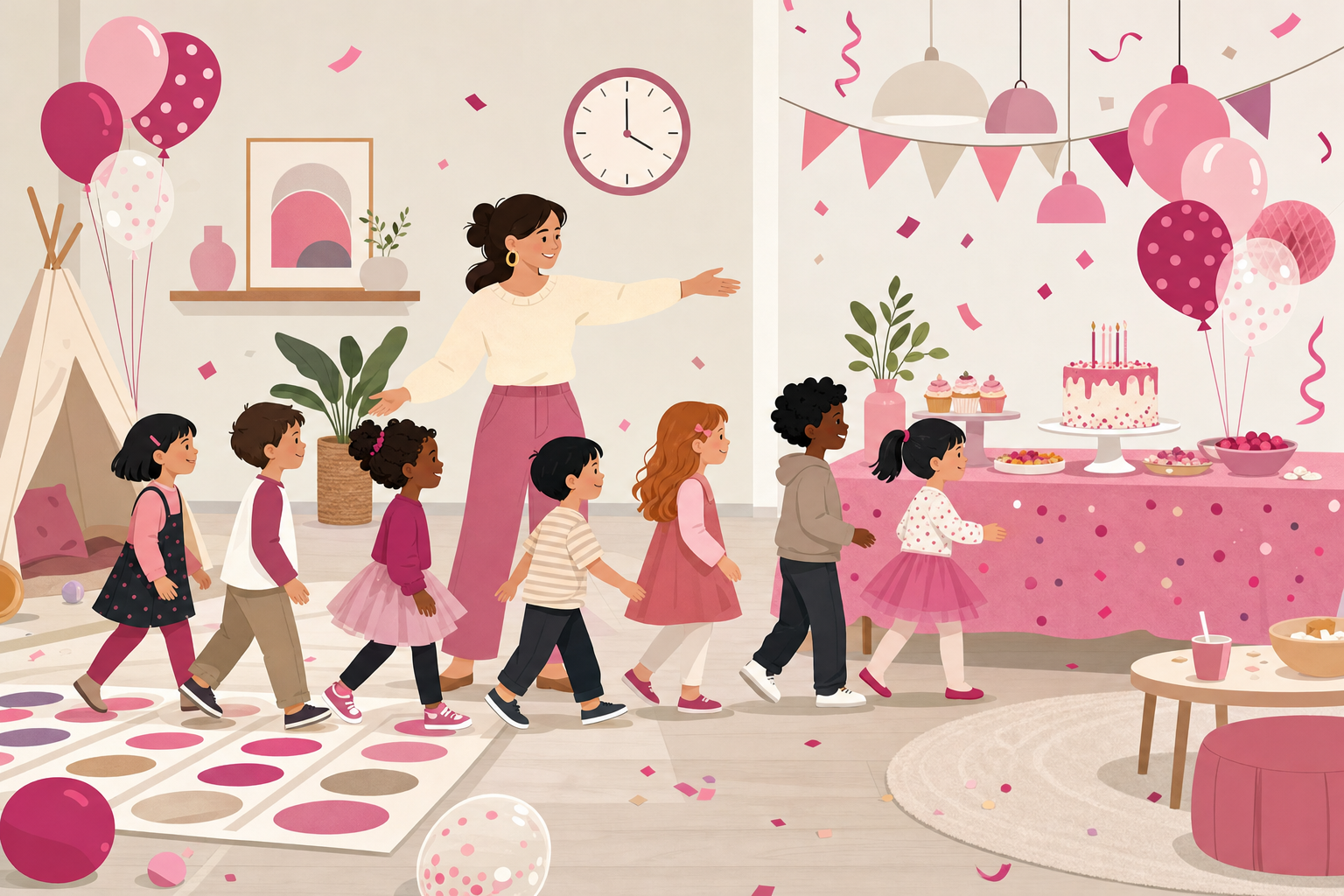
What to Do Between Birthday Party Games: A No-Chaos Transition Plan for a 90-Minute Kids' Birthday Party
The games aren't the problem. It's the 90 seconds after musical chairs ends, when six kids are sweaty and amped up with nowhere to put that energy, and you're still holding the Bluetooth speaker trying to figure out what's next. That gap is where parties go sideways: someone gets pushed, someone cries about losing, and two kids wander off to "explore" the garage.
Most party planning advice tells you to pick great games and rotate activities. That's true but incomplete. The real skill is managing the transitions between activities, especially when you're the only adult running the show and kids finish tasks at wildly different speeds. Here's a practical plan for filling those gaps so the party keeps moving without you having to referee chaos every five minutes.
Why the Gaps Cause More Problems Than the Games
Kids ages 3 to 10 have very different attention spans and energy levels, and a gap with no instructions is an invitation for them to invent their own fun, which is rarely the fun you want in your living room.
Three things happen in an unplanned gap:
- Fast finishers get bored and start roughhousing
- Slow finishers feel rushed or left out
- The birthday child, who is already overstimulated, has a meltdown because nothing is "happening"
The fix isn't more games. It's a short, repeatable transition routine you use every single time one activity ends and before the next one starts. Think of it as a 60 to 90 second buffer with a built-in job for every kid, not empty time.
The Minute-by-Minute 90-Minute Transition Map
Here's a realistic timeline for a 90-minute home party with 8 to 12 kids, built around short bursts of activity with planned, not improvised, transitions.
- 0 to 15 min: Arrival and free play. Low-key activity station out so early arrivers aren't just standing around.
- 15 to 25 min: Game 1 (high energy, like freeze dance or a relay)
- 25 to 28 min: Transition (water break + "find your seat" cue)
- 28 to 40 min: Game 2 (medium energy, team-based)
- 40 to 43 min: Transition (bathroom break, hand out craft materials)
- 43 to 55 min: Quiet activity station (craft or coloring table)
- 55 to 58 min: Transition (move to food area)
- 58 to 75 min: Food and cake. If you want a deeper breakdown of whether to serve food before or after games, this guide to birthday party food timing walks through the tradeoffs.
- 75 to 85 min: Game 3 (low-key, like a scavenger hunt)
- 85 to 90 min: Goodbye bags and pickup
The key detail is that every transition has a named task, not just "okay everyone, hang on a sec." A water break is a task. Finding a seat is a task. Kids follow instructions much better than they follow vague waiting.
Low-Prep Filler Activities for the In-Between Minutes
You don't need elaborate backup plans. You need two or three go-to fillers that require zero setup and can absorb anywhere from 90 seconds to 5 minutes.
- Call-and-response clapping. Teach one simple pattern at drop-off. Use it any time you need instant quiet.
- "Statue freeze." Call it mid-transition. Whoever moves last gets to pick the next song or game.
- Simple Simon for 60 seconds. No prep, no props, works for ages 4 and up.
- A rotating "helper" job. Ask one kid to be the line leader or the cup-passer for the next activity. Kids who feel useful stop looking for trouble.
- A question jar. A cup of silly "would you rather" cards. Pull one while you set up the next game.
These aren't the main event. They're duct tape for the seams between the main event, and that's exactly what makes a party feel smooth instead of chaotic.
Activity Stations Solve the Mixed-Age Problem
If your guest list spans ages 3 to 10, a single game rarely works for everyone at once. A 3-year-old can't follow relay race rules, and a 9-year-old will find duck-duck-goose boring within 90 seconds. Instead of one activity for the whole group, set up two or three simple stations kids can rotate through in small clusters.
- Station 1: A craft or coloring table. Themed coloring sheets from Chunky Crayon make an easy, low-mess station that older and younger kids can both sit with for a few minutes while you reset the main area.
- Station 2: A simple building challenge with blocks or cups.
- Station 3: A quiet sensory bin or bubble station for younger guests.
Stations work because kids self-pace. The ones who finish fast move on; the ones who need more time aren't rushed. For a full plan on getting kids who don't know each other well to actually play together at these stations, this 90-minute icebreaker plan has specific prompts that work even with shy guests.
If siblings of different ages are part of the mix and tend to bicker during downtime, the strategies in this guide to keeping siblings entertained indoors translate well to party stations too, since the core problem (different ages, same room, limited patience) is nearly identical.
When One Kid Finishes Way Before Everyone Else
This is the scenario that derails more parties than bad weather or a meltdown over presents: one fast kid finishes the craft, the game, or the scavenger hunt in half the time and now has nothing to do.
Handle it with a standing rule you explain once at the start: "When you're done, come find me for your next job." Then have three ready-made "next jobs" in your back pocket:
- Hand out cups for the next activity
- Start the music for the next song
- Hold the sign-in sheet or goodie bag basket
Giving a fast finisher a small responsibility keeps them from wandering off or stirring up trouble with kids who are still working. It also makes them feel important instead of singled out for being "too fast," which matters more than it sounds like it would at a kids' party.
The Takeaway
A calm 90-minute party isn't about finding the perfect games. It's about planning the 60 seconds after each one ends. Build in a simple transition routine, keep two or three no-prep fillers ready, set up stations instead of one big group activity, and give fast finishers a job instead of free time. Do that, and the gaps between games stop being where things fall apart and start being just another smooth part of the plan.