October 28, 2026
Mixed-Age Birthday Party at Home: One-Adult 90-Min Plan
Running a mixed-age birthday party solo? Get a low-prep 90-minute activity rotation that keeps kids ages 3 to 10 engaged. Grab the free timeline now.
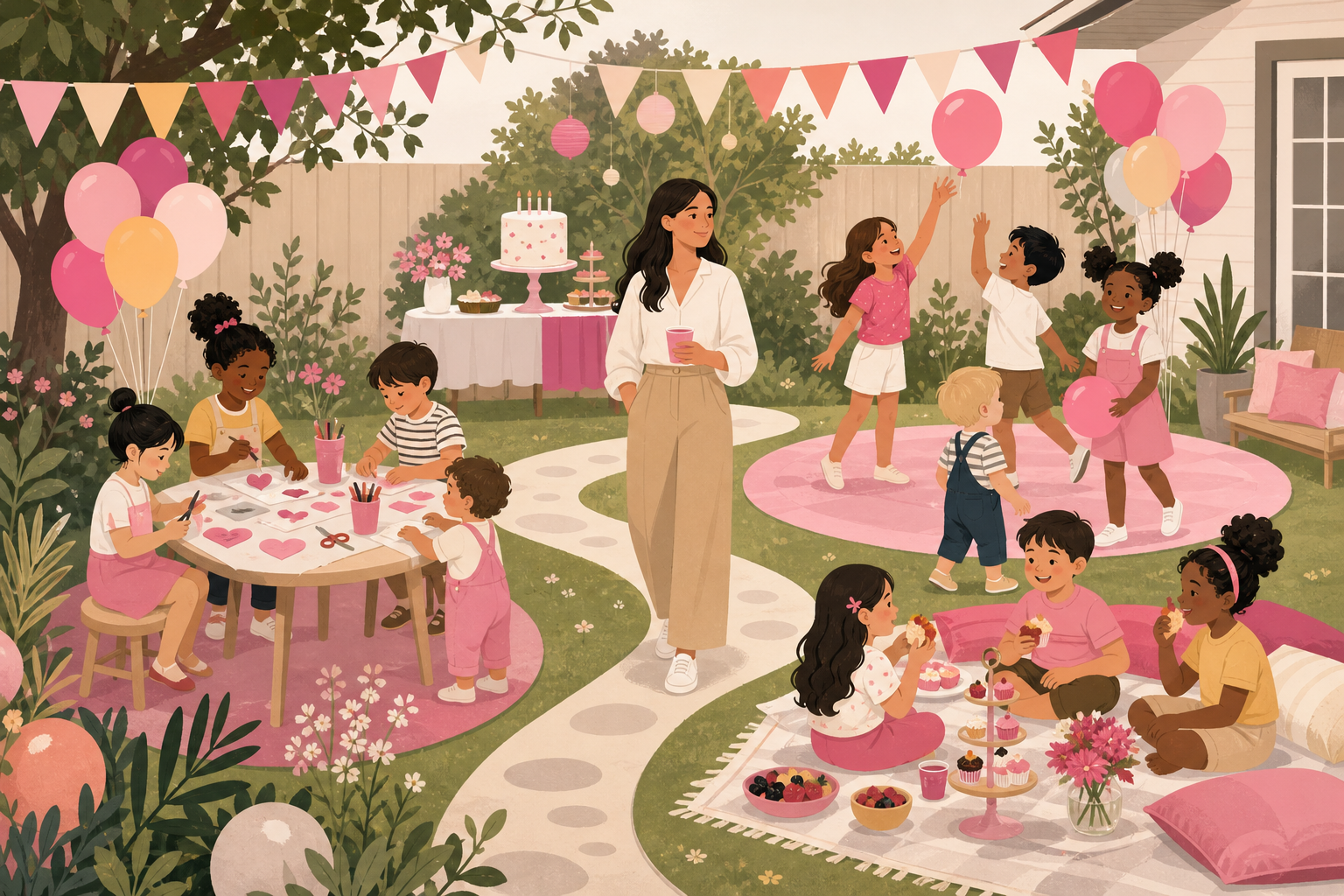
How to Run a Mixed-Age Kids Birthday Party at Home With One Adult: A 90-Minute Activity Rotation for Ages 3 to 10
You're hosting solo, your kid invited everyone from the 3-year-old cousin to the 10-year-old neighbor, and you have exactly one set of hands. The games you pin on Pinterest assume two adults, a craft table someone else is staffing, and kids who all want the same thing at the same time. None of that is your Saturday.
Here's a realistic plan: a 90-minute rotation built for one adult, with age-based adjustments baked in and a backup move for when an activity dies on the floor.
Why Mixed-Age Parties Fall Apart
The core problem isn't the games. It's that a 3-year-old and a 10-year-old have different attention spans, different motor skills, and different ideas of fun, and you can't run two separate parties at once.
Most activity lists tell you to "adapt for all ages" without saying how. The fix is structure: short blocks, built-in roles for older kids, and a rotation that moves before anyone gets bored or overwhelmed. If you're setting up right before guests show up, this 20-minute arrival plan pairs well with what follows, since early guests need something to do while you finish staging.
Set Up Before Guests Arrive (Keep It to 3 Stations)
With one adult, more stations means more chaos. Three is the limit. Set each one up fully before the first doorbell rings, because once kids arrive, you won't get five uninterrupted minutes.
Station 1: Low-mess craft or coloring table
Paper, crayons, stickers, maybe simple masks or headbands to decorate. This is your fallback zone all day, the place kids drift to when they need a break from running around. Themed coloring sheets from Chunky Crayon make an easy version of this station since you just print and go, no prep beyond paper and crayons.
Station 2: One big-movement game zone
Freeze dance, balloon volleyball, or a simple obstacle course using furniture and cushions you already own. Clear floor space, nothing breakable nearby.
Station 3: A hands-on sensory or building bin
Blocks, a sand or rice bin, magnetic tiles, or a simple scavenger hunt list. Good for kids who need a quieter, slower-paced option.
Three stations means three ready-made answers when a kid says "I'm bored," and you never have to improvise on the spot.
The 90-Minute Rotation, Minute by Minute
This is the actual mixed-age party timeline that keeps one adult in control without running between rooms.
0 to 15 min: Arrival and free play
Kids trickle in at different times no matter what the invite says. Point everyone to the craft table as they arrive. It absorbs stragglers without needing your full attention.
15 to 35 min: Big group game (all ages together)
Pick something with simple, adjustable rules, like musical statues or a balloon-keep-up-off-the-floor game. Give older kids a job: "You're in charge of counting to ten" or "You hold the music." That one move solves half your engagement problem, because older kids who feel useful stop complaining that the game is "too babyish."
35 to 55 min: Split by energy, not by age
Here's the trick most lists miss: don't split kids by age, split them by what they need right now. Route high-energy kids to the movement station and quieter kids to the sensory bin. You'll have both a 4-year-old and an 8-year-old at each spot, and that's fine, because the activity flexes rather than the age group.
55 to 70 min: Craft or coloring station, everyone together
This is a planned lull, not a backup. Bodies need a sit-down block after 40 minutes of running, and a shared table activity naturally quiets the room before food or cake. It also buys you five minutes to set out plates.
70 to 85 min: Second big group game
Energy usually spikes again after a snack or sit-down stretch. Repeat a simplified version of the earlier group game, or try a relay where older kids partner with younger ones (carrying a balloon on a spoon, walking an obstacle course two by two). Pairing ages instead of separating them turns a potential mismatch into the fun part.
85 to 90 min: Wind-down
Bring everyone back to the craft table or hand out a small take-home item while you cue up cake or goodbye routines. A quiet landing spot prevents the "everyone is overstimulated at pickup time" scramble.
For a visual version of this exact flow that you can print and tape to the fridge, the full mixed-age party schedule breaks the same 90 minutes into a printable timeline.
What to Do When an Activity Loses the Group
Every party has a moment where a game just dies, usually around the 10-minute mark when the youngest kids wander off and the oldest ones start negotiating new rules. Don't fight it. Here's the fallback:
- Call it, don't chase it. The second you notice kids peeling away, announce the next activity loudly and move. Don't try to win back a game that's already lost.
- Keep a 60-second reset in your pocket. "Freeze, everyone find a partner" or "Everyone grab something red" resets attention instantly and buys you time to pivot to the next station.
- Send one kid on a mission. Ask an older child to help you grab supplies or hand out the next activity's materials. It gives them a role, and it moves the group physically toward the next thing.
- Have a silent fallback ready. The craft table should always be ready to receive kids at any point in the 90 minutes, not just during its scheduled block. It's your safety net.
This is really the heart of how to keep different-age kids engaged: you're not trying to find the one game everyone loves equally. You're giving everyone a place to land every 15 to 20 minutes, so no one has time to get bored or burned out.
A Few Low-Prep Game Ideas That Actually Flex by Age
For the activity blocks above, these are easy to adjust on the fly without extra materials:
- Freeze dance: toddlers just stop moving, older kids add silly poses when they freeze
- Balloon volleyball: lower the "net" (a string or pool noodle) for younger kids, add a point system for older ones
- Scavenger hunt: give younger kids picture cards, older kids a written list
- Simon Says: let an older kid be "Simon" for a round, which keeps them invested instead of checked out
If the weather flips on you mid-party, it helps to have already decided your indoor cutoff; this rain day decision guide covers when to call it and move everything inside before guests even arrive.
The Short Version
You don't need a Pinterest board of 20 birthday party games for ages 3 to 10. You need three ready stations, a loose 90-minute rhythm, and a plan for the moment a game falls apart, because it will. Keep transitions fast, give older kids small jobs, and let the craft table be your quiet reset button all day long. One adult, one plan, and a party that actually runs itself.