June 27, 2026
Sensory-Friendly Birthday Party Ideas for Overwhelmed Kids
Plan a low-stress birthday party for easily overwhelmed kids with quiet zones, calm activities, and sensory-friendly setup tips (no diagnosis needed).
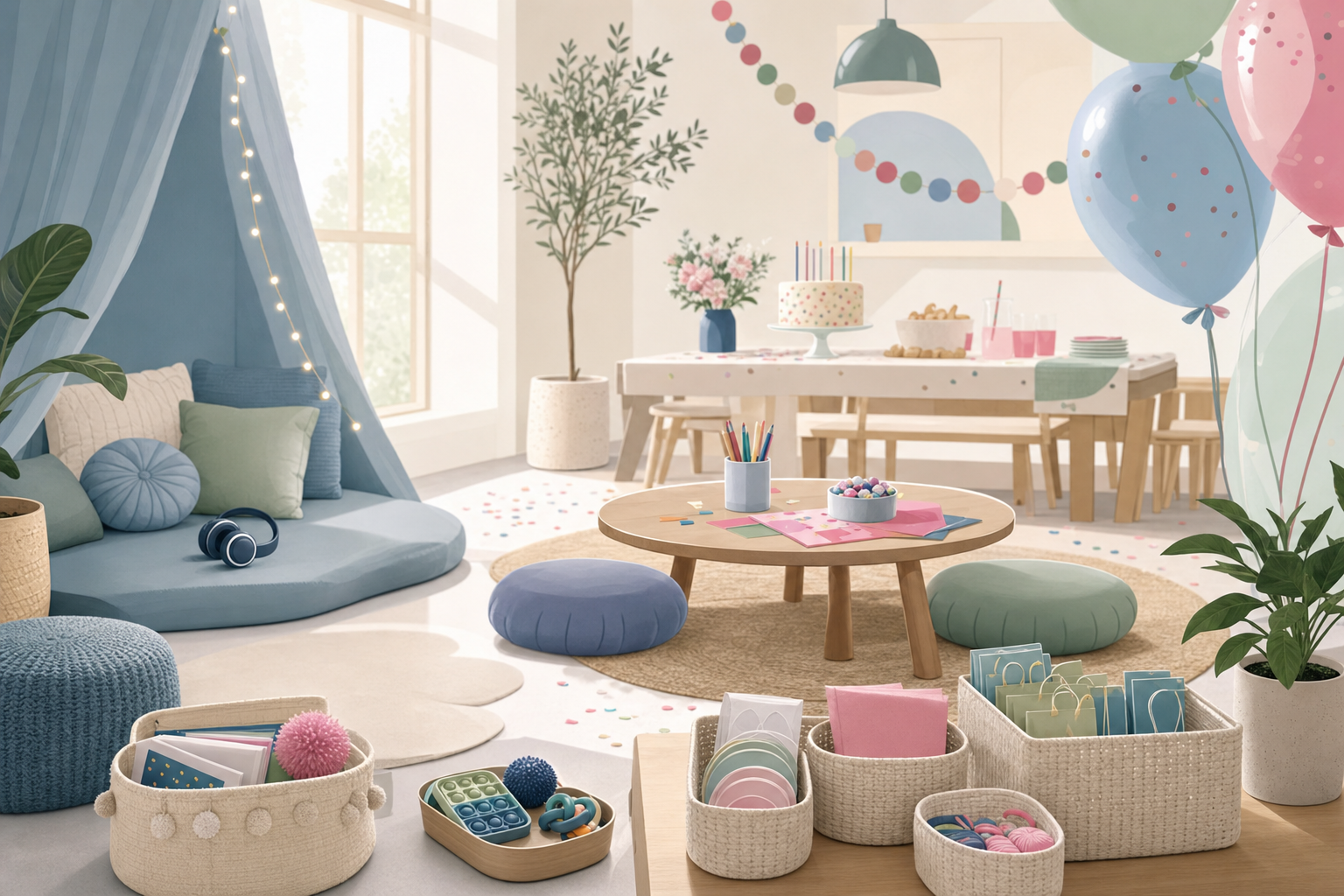
Sensory-Friendly Birthday Party Logistics for Easily Overwhelmed Kids (No Diagnosis Required): A Practical Setup Guide for Parents
Your kid loves their friends but melts down after 30 minutes of party chaos. The noise, the competition, the surprise transitions between activities all stack up until they're hiding under a table or sobbing in your lap while everyone else eats cake.
You don't need a diagnosis to recognize that some kids get overstimulated faster than others. And you don't need a clinical team to plan a birthday party that works for them. You just need a different setup, one that prevents overwhelm instead of reacting to it after the fact.
This guide walks through the practical logistics: how to physically arrange your space, which activities actually calm instead of escalate, and how to handle transitions without triggering a shutdown. These sensory-friendly birthday party ideas for kids work whether you're hosting at home, a park, or a rented space, and they don't require special certifications or expensive equipment.
Set Up a Quiet Zone Before the First Guest Arrives
Most party guides mention a "quiet corner" as an afterthought. But if you wait until a child is already overstimulated to point them toward a beanbag in the corner, it's too late. The quiet zone for birthday party kids needs to exist from the start, introduced as a normal part of the party, not a penalty box.
Pick a space that's visibly separated from the main action. A separate room is ideal, but if that's not possible, use a room divider, a large bookshelf, or even a pop-up tent to create a physical boundary. The key is that a child standing in the quiet zone can't see the chaos of the main party area.
Stock it with truly calming activities, not just "indoor" versions of high-energy games. Here's what works:
- A basket of books (picture books, not chapter books that require sustained focus)
- Large foam floor puzzles (30 pieces or fewer)
- A bin of soft stuffed animals or sensory toys like squishy stress balls
- Themed coloring sheets from Chunky Crayon and a small box of crayons (coloring is repetitive and rhythmic, which helps reset the nervous system)
- Headphones with gentle music or white noise already queued up on a device
Avoid anything with small pieces that require cleanup, competition, or social coordination. The quiet zone is for solo decompression, not parallel play.
Introduce the space during your welcome: "Hey everyone, we've got games and snacks over here, and if you need a break, there's a cozy spot in the next room with books and quiet stuff." Normalize it immediately so no child feels singled out for using it.
Choose Non-Competitive Birthday Party Games That Remove Winner/Loser Stress
Competitive games are the number one trigger for party overwhelm. Musical chairs, relay races, and elimination games create a pressure cycle: excitement spikes, then someone loses, then they feel rejected or embarrassed, then the sensory load of those big emotions pushes them over the edge.
For a low-stress birthday party for easily overwhelmed kids, swap competitive games for collaborative or open-ended activities where everyone participates at their own pace. Here are birthday party activities for kids who get overstimulated that actually work:
Scavenger hunts with no timer: Hide themed items (plastic dinosaurs, foam shapes, small toys) around the space. Every child gets a bag. There's no race, no first-place prize. When someone finds an item, they put it in their bag and keep looking. Everyone wins because everyone gets to take home what they found.
Freeze dance without elimination: Play music, kids dance, music stops, everyone freezes. But instead of eliminating kids who move, just keep playing. The fun is in the freezing, not in being the last one standing. You can even let kids take turns picking the next song or calling out silly freeze poses ("Freeze like a flamingo!").
Collaborative building challenges: Dump out a huge bin of blocks, Duplos, or cardboard boxes. Set a group goal: "Let's build the tallest tower we can all fit under" or "Let's make a town with roads connecting all the buildings." Kids work together, and there's no losing.
Sensory stations: Set up three or four stations around the space (playdough table, water bead sensory bin, bubble wrap stomping zone, kinetic sand). Kids rotate through at their own pace. No instructions, no rules, no performance pressure. If you're looking for more ideas that translate well to party formats, this collection of no-supply boredom busters for 4-year-olds includes several activities that work great as open-ended stations.
The goal is to remove the social comparison element. Kids can engage fully without worrying about whether they're winning or losing.
Manage Transitions with a Visual Timeline (Not Surprise Announcements)
Surprise transitions are brutal for kids who need predictability. If you suddenly announce "Okay, everyone stop playing, it's cake time!", you're asking overstimulated kids to shift gears instantly while their nervous system is still amped up from the previous activity.
A visual timeline solves this. Make a simple poster with pictures or words showing the party flow: Arrival, Activity 1, Snack, Activity 2, Cake, Goodbyes. Use clip art, hand-drawn icons, or just printed text in large font. Hang it at kid eye level near the entrance.
When you transition between activities, reference the chart: "We're finishing up the scavenger hunt, and next on our timeline is snack time." Give a five-minute warning, then a two-minute warning. This gives overwhelmed kids time to mentally shift gears instead of being jolted into the next thing.
If your child already uses visual supports at home, this will feel familiar. If not, it still works because it removes the uncertainty of "what's happening next?" which is a major anxiety trigger. The approach is similar to visual routine charts that help 3-year-olds follow instructions, just applied to party logistics instead of daily routines.
Keep the Sensory Load Low from the Start (Lighting, Noise, Crowding)
Sensory-friendly party setup (no diagnosis needed) isn't about accommodating a disability. It's about recognizing that some environments are objectively harder on everyone's nervous system, and kids with lower thresholds just hit their limit faster.
Here's how to reduce the baseline sensory load before the party even starts:
Sound: Skip the continuous background music or keep it very low. Music plus conversation plus activity noise equals an overwhelming wall of sound. If you want music for specific activities (like freeze dance), play it only during that activity, then turn it off.
Lighting: If you're indoors, use lamps instead of overhead fluorescents. Dim the lights slightly or open curtains for natural light. Harsh, bright lighting adds to sensory fatigue even if kids can't articulate why they feel "buzzy."
Crowding: Limit your guest list. Seriously. A party with 8 kids in a large space is calmer than 15 kids in the same space. If your child gets overwhelmed, a smaller group with more room to move prevents the claustrophobic "too many people" feeling that escalates quickly.
Food: Serve familiar, plain foods alongside any themed treats. A kid who's already managing sensory input doesn't need the additional stress of unfamiliar textures or strong flavors. Goldfish crackers, apple slices, and plain popcorn are boring to you but comforting to them.
These adjustments don't make the party less fun. They just make it sustainable for kids whose systems process input differently.
Have an Exit Plan That Doesn't Feel Like Failure
Even with all these modifications, some kids will still hit their limit before the party ends. That's not a planning failure. That's just how their nervous system works.
Decide in advance what your exit strategy looks like. If you're hosting at home, identify a separate room where your child can fully remove themselves (not the quiet zone, which is still party-adjacent, but their bedroom or another private space). If you're at a park or venue, know where you can walk them for a full break (the parking lot, a trail, the car).
Let your child know before the party: "If you need to take a big break, just tap my arm and we'll go to your room for a few minutes. You can come back when you're ready, or you can stay there. Either one is fine."
This removes the shame and the negotiation. They're not "ruining" their own party by needing a break. They're just managing their own nervous system, which is a skill you want them to practice.
If they end up spending the last 30 minutes of their party in their room while friends finish cake in the other room, that's okay. They still had fun. They just needed it in smaller doses.
Practical Sensory-Friendly Birthday Party Ideas for Kids: What This Actually Looks Like
Here's a realistic two-hour timeline for how to plan a calm birthday party for high-energy kids:
0:00-0:15, Arrival and free play: Quiet zone is already set up and introduced. Kids trickle in, grab a name tag, and start with open play (blocks, coloring, sensory bin). No structured game yet because not everyone is here and you're not forcing latecomers to jump into something mid-stream.
0:15-0:45, Collaborative activity: Scavenger hunt or group building challenge. No winners, no pressure. The visual timeline shows this is happening now.
0:45-1:00, Snack time: Kids sit and eat. This is a natural sensory break because eating is grounding. Play soft music if you want, but keep conversation volume low.
1:00-1:30, Second activity: Freeze dance (no elimination), sensory stations, or another open-ended option. Give a five-minute warning before this starts.
1:30-1:50, Cake and singing: Sing, eat, wind down. This is the lowest-energy part of the party by design.
1:50-2:00, Goodbyes and take-home bags: Kids grab their scavenger hunt loot or a small favor bag and leave. No lingering, no extended goodbyes that drag out the overstimulation.
Notice what's missing: no relay races, no musical chairs, no surprise transitions, no loud music loop. It's still a party. It's just engineered to keep the sensory ceiling manageable. If you need more structured help with pacing, this 2-hour birthday party timeline for 5-year-olds walks through a similar no-games flow that prevents overwhelm.
You're not throwing a "therapy party." You're just throwing a party that doesn't require your kid to white-knuckle their way through their own celebration. That's not limiting. That's smart.
These birthday party quiet corner ideas and low-stress logistics work for any kid who needs them, whether they have a formal diagnosis, a suspected sensory processing difference, or just a personality that thrives on calm and predictability. You don't need permission to plan a party that actually fits your child. You just need a clear setup and the confidence to skip the chaos.