June 15, 2026
Simple At-Home Birthday Party Ideas for Kids (Ages 4 to 8)
Discover easy birthday party activities for mixed-age kids with craft stations, free play, and a stress-free timeline. Perfect for busy parents planning at home.
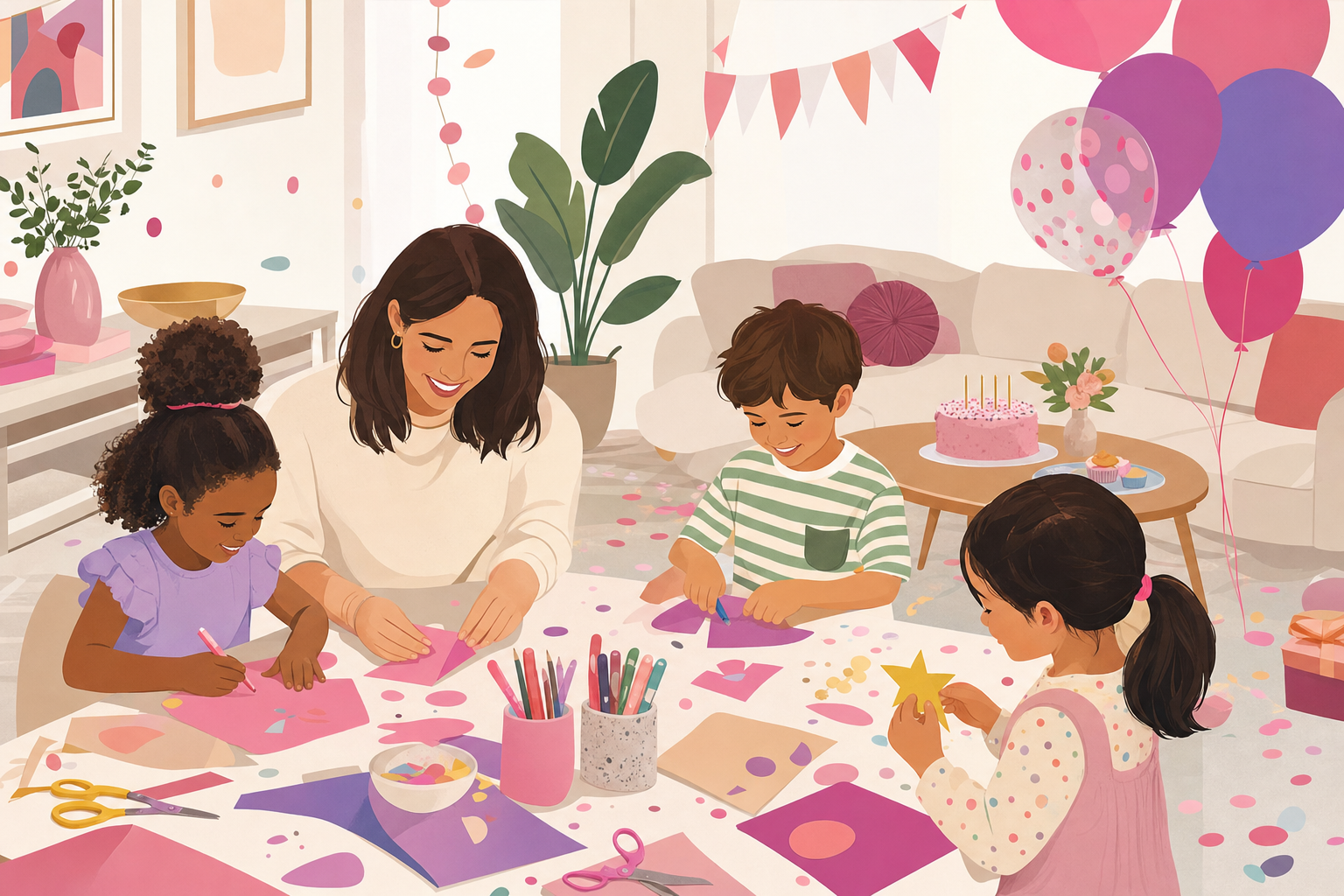
How to Plan a Simple At-Home Birthday Party for a 4- to 8-Year-Old with One Craft, Free Play, and Zero Overwhelm
You want to throw your child a birthday party that feels special without turning your living room into a three-ring circus or spending the week before Pinterest-perfect crafting. You have a mixed-age guest list, one or two adults helping, and about 90 minutes before the kids start melting down. You need a plan that keeps everyone busy without requiring a full entertainment schedule.
Here's the structure that works: one guided craft station, a chunk of truly free play, and a timeline short enough that no one gets bored or overstimulated. This is the low-stress birthday party at home that lets you actually enjoy watching your kid blow out candles instead of refereeing chaos.
Why a Short Party with Minimal Structure Actually Works Better
Kids aged 4 to 8 have about 60 to 90 minutes of focused party energy before they start getting tired, cranky, or too wound up. A two-hour party sounds generous, but it usually means the last 30 minutes devolve into kids running wild, parents checking their watches, and you desperately trying to stretch activities.
A one-hour kids birthday party plan gives you just enough time for arrival, one structured activity, free play, and cake. Everyone leaves happy, no one has a meltdown in your hallway, and you skip the awkward phase where half the kids are done and the other half are still arriving.
For mixed-age groups, structured games often fail because the 4-year-olds don't understand the rules and the 8-year-olds get bored. A craft station and open play let each kid engage at their own level without you needing to referee.
The 60- to 90-Minute Party Timeline That Keeps Kids Engaged
Here's the simple at-home birthday party timeline that prevents both chaos and dead air:
0 to 15 minutes: Arrival and immediate craft station
Kids trickle in at different times, so don't plan a group activity that requires everyone to start together. Set up a craft station where each child can jump in the moment they arrive. Think decorated picture frames, build-your-own crown, or decorate-a-cupcake (not eat it yet, just frost and sprinkle). This keeps early arrivals busy and gives latecomers something to do without feeling behind.
Themed coloring sheets from Chunky Crayon work well here if you want a zero-prep craft option that still feels festive.
15 to 45 minutes: Free play with intentional zones
Once most kids have finished the craft, step back and let them play. This is not lazy party planning. This is you understanding that kids this age want to run around, build things, and make up games without an adult micromanaging every minute.
Set up two or three play zones so the space doesn't feel chaotic:
- A building zone with blocks, magnetic tiles, or cardboard boxes
- An active zone for running, dancing, or a simple obstacle course (couch cushions, painter's tape floor lines)
- A pretend-play zone with dress-up clothes, stuffed animals, or a play kitchen
You're not facilitating. You're just making sure there are options so kids naturally spread out instead of all trying to do the same thing.
This approach overlaps with ideas in our guide to a 90-minute backyard birthday party plan, which also prioritizes free play over structured games.
45 to 60 minutes: Cake, singing, quick present opening (optional)
Call everyone to the table, sing, blow out candles, eat cake. If your child wants to open presents, keep it fast by having a designated gift-bag zone and only opening cards. Most kids this age care more about the cake than watching someone else open gifts.
60 minutes: Parents arrive for pickup
End on time. The kids are still happy, the sugar hasn't fully kicked in, and you avoid the post-party crash.
The Best Birthday Party Craft Station for Kids (That Doesn't Require a Glue Gun)
Your craft needs to meet three criteria: quick to explain, hard to mess up, and something kids can take home immediately.
Skip anything that requires drying time, multiple steps, or an adult hovering. Here are birthday party craft station ideas that work for ages 4 to 8:
- Decorate a canvas tote bag or pillowcase with fabric markers. Each kid gets one, draws whatever they want, takes it home. No drying, no assembly.
- Build a cardboard superhero mask or animal ears with pre-cut shapes, markers, stickers, and elastic string. You prep the base shapes; they decorate.
- Design your own bookmark with cardstock strips, stickers, stamps, and a hole punch with ribbon. Fast, portable, actually useful.
- Create a slime cup or playdough kit by letting kids mix their own color and add-ins (glitter, small beads). Portion everything into individual cups ahead of time so it's not a free-for-all.
Set the craft station up before the first guest arrives. Lay out all supplies, put one example on display, and designate a drying rack or take-home bag station. Kids should be able to start without you explaining every step.
How to Keep Birthday Party Activities for Mixed-Age Kids from Flopping
When you have 4-year-olds and 8-year-olds at the same party, you need activities that scale naturally without you running two separate events.
For the craft station: Offer the same base activity but let older kids add complexity. A 4-year-old will stick three stickers on a frame and call it done. An 8-year-old will arrange a whole pattern and add details. Same activity, different engagement levels.
For free play: Older kids often naturally include younger ones if you set up cooperative activities instead of competitive games. Building a giant block tower together works. A relay race where the 4-year-old has to keep up with the 8-year-old does not.
Skip structured group games entirely. Musical chairs, Simon Says, and scavenger hunts sound fun but almost always end with someone in tears because the rules weren't clear or a younger kid didn't understand. Free play lets every child participate at their own speed.
If your guest list skews toward very different interests, check out our post on birthday parties for mixed interests, which covers how to balance group dynamics when kids don't all want the same thing.
Easy Birthday Party Schedule Tips That Reduce Your Stress
The goal is not a perfect party. The goal is a party where you don't spend the whole time managing logistics.
Prep the day before, not the morning of. Set up the craft station, arrange the play zones, and put the cake in the fridge. The morning of the party, you should only need to set out cups and napkins.
Assign one other adult to greet parents at the door. You focus on the kids; someone else handles the small talk and the "where should I put the gift?" questions.
Put out the food in stages. Snacks during free play, cake at the end. Don't set out a full snack table at the beginning unless you want kids grazing instead of playing.
Use a visible timer for transitions. Set a phone timer for five minutes before cake time and give a heads-up: "Five more minutes of playing, then we're doing cake!" This prevents the abrupt shutdown that leads to whining.
Have a backup indoor option if you planned outdoor play. A simple rain plan (like our rain plan for kids birthday party guide) means bad weather doesn't derail your whole event.
When to Skip the Full Party and Do Something Smaller
Not every kid wants a big party. If your child gets overwhelmed by noise and crowds, a simple at-home birthday party with two or three friends and the same structure (craft, free play, cake) works just as well. Check out our guide on low-stress birthday parties for shy kids for more ideas.
You also don't need to invite the whole class if your space or budget doesn't allow it. A smaller group means less chaos and more actual connection. Your kid will remember playing with their favorite friends, not whether 15 people showed up.
What This Party Looks Like in Real Life
Here's what this simple birthday party schedule for 4-year-olds (or any age in the 4 to 8 range) actually looks like:
Guests arrive. Each kid immediately sits down at the craft table and decorates a canvas bag while you greet parents. Latecomers join without disrupting anything. After 15 to 20 minutes, most kids finish and drift toward the play zones. A few keep decorating; that's fine.
The next 30 minutes are loud and chaotic in the best way. Kids build a block tower, knock it down, rebuild it. A couple of them put on dress-up clothes and make up a game. Two others line up stuffed animals and assign them roles. You refill water cups, take a few photos, and don't intervene unless someone's crying.
You call everyone to the table. They sing, your child blows out candles, everyone eats cake. Parents start arriving right as the sugar kicks in, and everyone leaves happy.
You clean up in 20 minutes instead of two hours because you didn't scatter 47 different activities across three rooms.
That's the party. No entertainer, no themed games, no stress about whether the kids are "having enough fun." They had cake, they played with friends, and your child felt celebrated. That's what a simple at-home birthday party for kids is supposed to be.